
Business Friction Audit
Where is friction costing your business?
A slow page. An enquiry with no reply. Details typed in twice. A quote waiting for a signature. Each looks small. Together they slow revenue, soak up energy and money, and create risk. The Business Friction Audit finds them, puts a value on each one and sets the order to fix them.
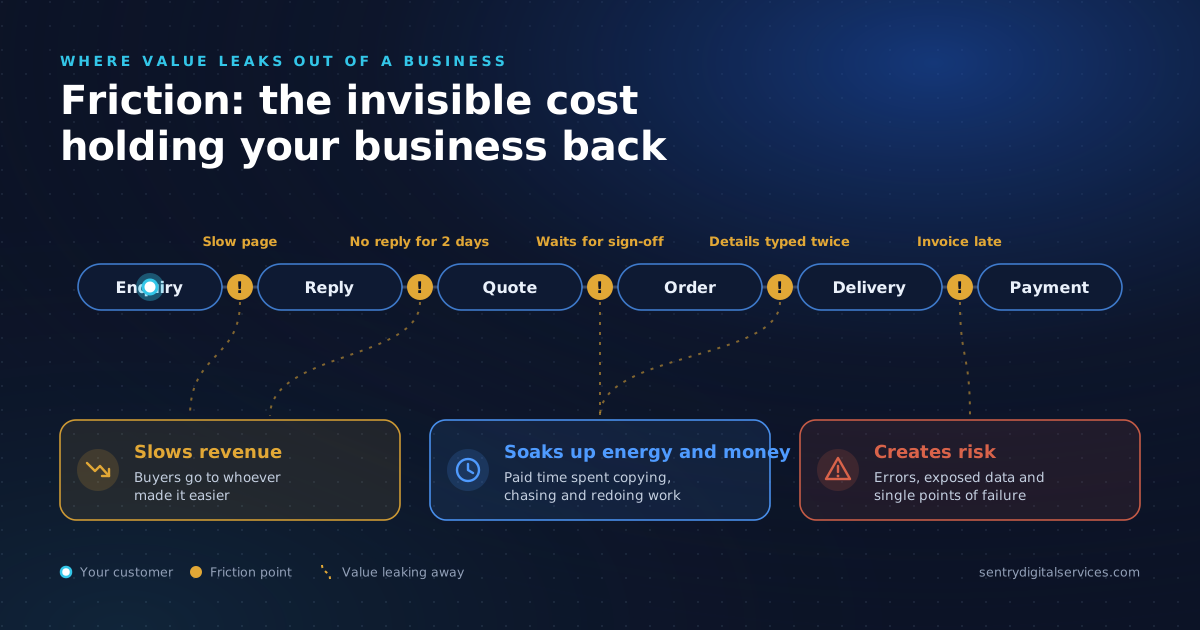
What friction does
Three costs most businesses never measure
Slows revenue
Prospects wait for replies, quotes go out late and buyers go to whoever made it easier.
Soaks up energy and money
Skilled, paid people spend their days copying, chasing, waiting and redoing work.
Creates risk
Every manual handoff is a chance for an error, and customer data copied into spreadsheets and inboxes is harder to secure.
Does this sound familiar?
Eight ways to know you have friction
- 1
You have complaints
Every complaint is friction a customer could see. Others may have left without saying a word.
- 2
Your results are sporadic
A good month, then a poor one, with no clear reason why.
- 3
There is no plan and no goals
Nobody can tell when part of the business is falling short, so friction stays invisible.
- 4
There are no measures for each part of the customer journey
At the very least, each department should know its numbers.
- 5
Growth or return on investment has stalled
You spend more, and revenue or margin does not move to match.
- 6
Everything goes through you
Decisions, approvals and problems all land on the owner's desk.
- 7
The same mistakes keep happening
Credit notes, refunds, returns and redone work, month after month.
- 8
Payments arrive long after the work is done
Invoices go out late or wrong, and the time customers take to pay creeps up.
If several of these sound familiar, friction is already costing you. The question is how much.
Where we look
Five places friction hides
| Area | What friction looks like | What we measure |
|---|---|---|
| Technology | Slow pages, systems that do not share data, the same details typed in twice | Page speed on key pages, duplicate records, integration errors |
| Process | Repeated requests for the same information, approval queues, rework | End-to-end cycle time, quote turnaround, rework rate |
| Customers | Enquiries with no reply, unclear next steps, repeat contacts | Enquiry conversion, time to first response, repeat contacts per issue |
| Staff | Switching between applications, copying data, chasing colleagues | Hours a week on manual work, errors per 100 transactions |
| Management | Nobody owns the full journey, workarounds accepted | Cost to serve each customer, time to decision, one end-to-end journey measure |
How it works
Seven steps, with a stopwatch
Most friction stays hidden because nobody looks at the whole journey from start to finish. We fix the process before the technology: understand the journey, measure the friction, simplify the process, then choose the technology.
- 1
Choose the journeys that matter
One to three journeys with the most money at stake, such as enquiry to signed order or support request to resolution.
- 2
Walk the journey as your customer
We make a real enquiry by website, phone and email and record every step: load time, form fields, whether a confirmation arrives, how long until a person replies.
- 3
Walk it again as your team
Every system opened, every copy and paste, every approval waited for, every spreadsheet bridging a gap.
- 4
Check the technology
Page speed against Google's Core Web Vitals, and where the same information is entered twice.
- 5
Check the management layer
Who owns each journey, which measures reach the management team, how long decisions take.
- 6
Put a value on each friction point
In your own numbers: staff hours, lost enquiries, delays against your sales cycle. Estimates are labelled, with the inputs shown.
- 7
Rank and recommend
Each friction point gets a priority. Security and compliance gaps come first, and every finding says what happens if you leave it.
What you get
A written feedback report
A map of each journey
Every step and handoff, with its friction points marked.
The value at stake
What each friction point is costing, in your own numbers.
The order to fix them
Priorities set by how often it happens, what it costs and what it takes to fix.
The measures to track
So you can see the improvement in your own numbers, not take it on trust.
What findings look like
| Friction point | If you leave it | Priority | First fix |
|---|---|---|---|
| Website enquiries get no reply for two working days | Prospects who need a quick answer buy from the first supplier to reply | High | An automatic confirmation that says when they will hear back; a named person for every enquiry |
| Quotes need director sign-off at any value | Routine repeat business lost to faster competitors | High | An approval limit so standard quotes go out the same day |
| Survey notes are typed in twice | A day added to every quote, and rekeying errors | Medium | Capture the survey once on a tablet form that feeds the quoting software |
An illustrative example, not a client result.
Two ways to start
Prices
Discovery call
Free
One hour. We talk through where friction shows up in your business and which customer journey is worth looking at first. No obligation.
Business Friction Audit
£470 + VAT
Discovery, the audit itself and a written feedback report: your friction points, what each one is costing, and the order to fix them.
Questions
Frequently asked
What is friction?
Any step, delay or repeated effort that stands between a person and what they are trying to do, and adds nothing to the result. The person might be a prospect trying to buy, a customer trying to get help, or someone on your team trying to finish a task.
What does the audit cost?
The discovery call is free and takes one hour. The Business Friction Audit is £470 plus VAT and covers discovery, the audit and a written feedback report.
Is all friction bad?
No. Security checks, identity verification, regulatory requirements and financial approvals protect the business. The aim is to remove unnecessary friction, and make the essential controls proportionate and easy to complete.
Will you try to sell us software?
We fix the process before the technology. Automating the wrong process only makes the wrong process faster, so technology is recommended only where it removes a real constraint.
Free service sheet
Business Friction Audit — brochure
The three costs of friction, eight ways to know you have it, the five places it hides, how the audit works in seven steps, what you get and the two ways to start.
Start free
Find your biggest measurable constraint
Book a free one-hour discovery call. We talk through where friction shows up in your business and which customer journey is worth looking at first. No obligation.